Spanish of the U.S. Southwest: A Language in Transition. by Rivera-Mills Susana Villa Daniel (eds.)
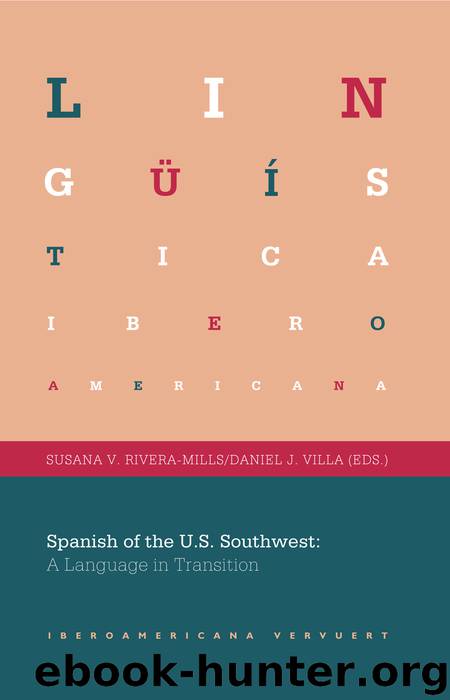
Author:Rivera-Mills, Susana,Villa, Daniel (eds.)
Language: spa
Format: epub
Publisher: Vervuert Verlagsgesellschaft
Published: 2010-04-17T04:00:00+00:00
Appendix: Transcription Conventions (Du Bois et al. 1993)
PASSIVE EXPRESSIONS AS ISOGLOSS BETWEEN NEW MEXICAN AND CALIFORNIAN SPANISH DIALECT AREAS
PATRICIA GUBITOSI
University of Massachusetts Amherst
Introduction
Scholars have shown that a change from periphrastic passive (ser+ past participle) to passive se (se+ active tense) is occurring in the Spanish passive voice system, and that this change is more evident in oral communication (Alonso & Henríquez Ureña 1946: 108, Roca Pons 1958: 15). One of the premises for linguistic change is that when two forms in any language express the same meaning, there is a distinct possibility that one of them will become extinct. As Mendikoetxea (1999: 1669) establishes, the extension of the use of the passive se has contributed to the disappearance of the periphrastic passive. Although these scholars argue that the use of se is increasing, there is scant statistical evidence, based on empirical data, to support this position. This chapter contributes to the study of passive expressions in modern Spanish by demonstrating a shift from periphrastic passive towards passive se in California and New Mexico Spanish.
The geographic areas studied here underwent years of socio-political turmoil that affected the cultures of the residing communities in disparate manners. California and New Mexico were part of the Viceroyalty of New Spain from 1535 until 1821 when Mexico won its independence; at that point they formed some of the northernmost regions of the Mexican Republic. In 1848, as a result of the Treaty of Guadalupe Hidalgo, California and New Mexico were ceded to the United States. At that time, both territories presented a similar use of the passive voice; however, the deep social changes that occurred in California and New Mexico motivated a different development of the passive voice and therefore gave rise to two dialect areas.
This study will show that California and New Mexico developed different preferences regarding the use of passive voice after they became part of the United States: while California shows a distinctive and increasing preference for passive se over time, New Mexico is more conservative and tends to retain the periphrastic passive, with the consequence of creating two distinct dialectal areas.
Download
This site does not store any files on its server. We only index and link to content provided by other sites. Please contact the content providers to delete copyright contents if any and email us, we'll remove relevant links or contents immediately.
Spell It Out by David Crystal(36109)
Life for Me Ain't Been No Crystal Stair by Susan Sheehan(35800)
Cecilia; Or, Memoirs of an Heiress — Volume 1 by Fanny Burney(32543)
Cecilia; Or, Memoirs of an Heiress — Volume 2 by Fanny Burney(31939)
Cecilia; Or, Memoirs of an Heiress — Volume 3 by Fanny Burney(31928)
The Great Music City by Andrea Baker(31915)
Professional Troublemaker by Luvvie Ajayi Jones(29648)
The Secret History by Donna Tartt(19037)
We're Going to Need More Wine by Gabrielle Union(19032)
Twilight of the Idols With the Antichrist and Ecce Homo by Friedrich Nietzsche(18618)
All the Missing Girls by Megan Miranda(15935)
Cat's cradle by Kurt Vonnegut(15328)
Pimp by Iceberg Slim(14480)
Bombshells: Glamour Girls of a Lifetime by Sullivan Steve(14046)
For the Love of Europe by Rick Steves(13885)
Talking to Strangers by Malcolm Gladwell(13342)
Norse Mythology by Gaiman Neil(13341)
Fifty Shades Freed by E L James(13230)
The Social Justice Warrior Handbook by Lisa De Pasquale(12183)
